
You’re standing in front of your building, looking up at the twelfth floor, then at the refrigerator, then at the stairwell. The question hangs in the air: should I haul it by hand, install a ramp, or call a crane? There’s no definitive answer, but there are parameters that quickly sort everything out.
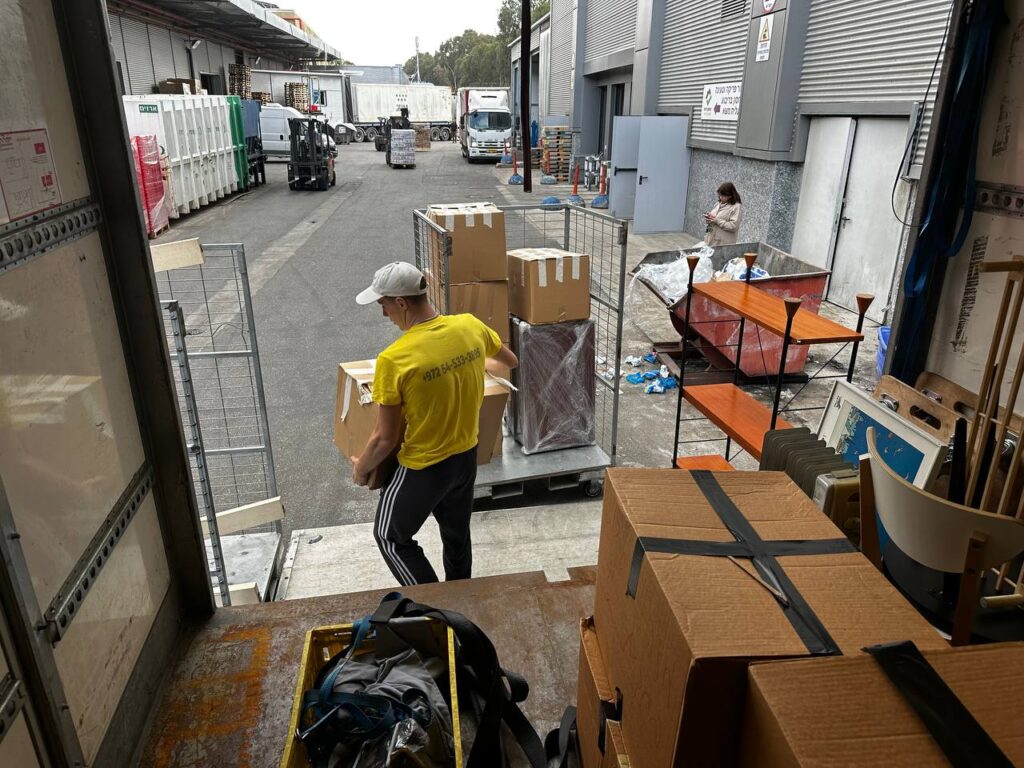
I’ll start with the elevator. If it’s a freight elevator, with ample height and width, and the floor isn’t higher than the seventh or eighth, a hydraulic ramp on a truck plus a standard dolly will do the trick. The ramp lowers the load almost to the asphalt, the movers roll it in, and lift it up to the floor. Slower than a crane, but cheaper and without unnecessary approvals. We moved in Bat Yam. The building was new, the elevator was spacious, and the sofa was a corner sofa, but it could be disassembled. The guys hauled it in twenty minutes, without any special equipment. The client was even surprised they didn’t have to pay for a crane.
But if the elevator is cramped and the floor is over ten, the math changes. Narrow doors, low cabin ceilings, right-angle turns. This is where a ramp comes into its own. A crane or aerial platform lifts the load straight out the window or onto the balcony. Yes, it’s more expensive. Yes, you need to negotiate with the management company, and sometimes get permission to close the sidewalk. But you save the movers’ hours and stress, and therefore yours. I saw guys trying to drag a three-meter-long wardrobe through the stairwell of a Stalin-era building. They ended up cutting the corner, scratching the walls, and paying more for the entrance hall repairs than renting a crane for an hour and a half would have cost.
There’s another detail that’s rarely discussed in advance: the width of the stairwells and the presence of landings. A hydraulic ramp is good when the steps are smooth, without sharp edges, and the turns allow for a turn. In older buildings, staircases often have spiral staircases or narrow winder steps. There, machinery is useless. Only a crane or manual furniture disassembly is necessary, which also takes time and money.
Weather also plays a role. Windy days, rain, or icy conditions mean the crane is out of the question. Equipment simply won’t work in such conditions; it’s a safety issue. A ramp and manual lifting are then the priority, if the structure allows. You either have to reschedule the move or pack everything tightly and lug it up the stairs. The choice is unpleasant, but realistic.
The cost difference is significant. Renting a crane with an operator typically costs between 1,500 and 3,000 shekels per call, depending on the height and accessibility. The ramp is included in the base rate, with additional charges based on the number of floors and weight. If you have a lot of items, but all standard ones, it’s more cost-effective to use a ramp. If you’re dealing with one or two large items, like a piano, a safe, or a non-detachable sofa on the fifteenth floor, the crane pays for itself instantly. Not only in terms of money, but also in the avoidance of bruises and damaged furniture.
Sometimes clients ask if they can “save money and try a ramp, and if that doesn’t work, quickly order a crane.” Theoretically, yes. In practice, this means double downtime, recalculations, and the crew is already stressed. It’s better to estimate in advance. Photograph the inside of the elevator, measure the doorway, and estimate the dimensions of the heaviest item. Even rough estimates will help the dispatcher honestly say: “Drag it” or “Call the tower.”
Ultimately, the decision comes down not to the principle of “what’s best” but to simple logistics. A crane is for exceptions, when clearances or floors violate the standard plan. A ramp is for everyday moves where there is at least minimal access and predictable conditions. The key is not to guess, but to look at the numbers and the walls. A miscalculation is more expensive than calling the right equipment.